
Preparing for AWS CLF-C02 is not difficult because AWS lacks learning resources. The real challenge is knowing what deserves your attention. I have seen learners spend weeks exploring the wrong topics while missing the cloud concepts that actually shape their exam results and future careers.
The Problem With AWS CLF-C02 Preparation Today
When I review how candidates prepare for the AWS Cloud Practitioner certification, I notice a consistent challenge: many learners begin with AWS service names instead of understanding the decisions behind those services.
They create long notes about Amazon EC2, Amazon S3, AWS Lambda, Amazon RDS, and dozens of other products. After studying, they may recognize the terminology, but they struggle when a question describes a business situation and asks them to choose the right approach.
That difference matters.
Cloud professionals do not choose AWS services because they remember a definition. They choose them because they understand requirements. A company might need lower operational effort, stronger security controls, better availability, or a more flexible pricing model. The correct AWS solution depends on the problem being solved.
This is where many CLF-C02 exam preparation strategies become inefficient. Learners treat AWS like a catalog of products instead of a technology ecosystem where services work together.
AWS has hundreds of services, but the Cloud Practitioner exam does not expect you to understand every product deeply. It evaluates whether you understand cloud fundamentals, AWS value, security principles, pricing concepts, and the purpose of major services.
The candidates who perform well usually build a clear mental model:
- Why companies use cloud platforms
- How AWS services solve different business needs
- How security and cost influence decisions
- How AWS services connect together
Once you understand these relationships, unfamiliar questions become easier because you are reasoning from principles instead of relying only on memory.
What AWS CLF-C02 Actually Measures
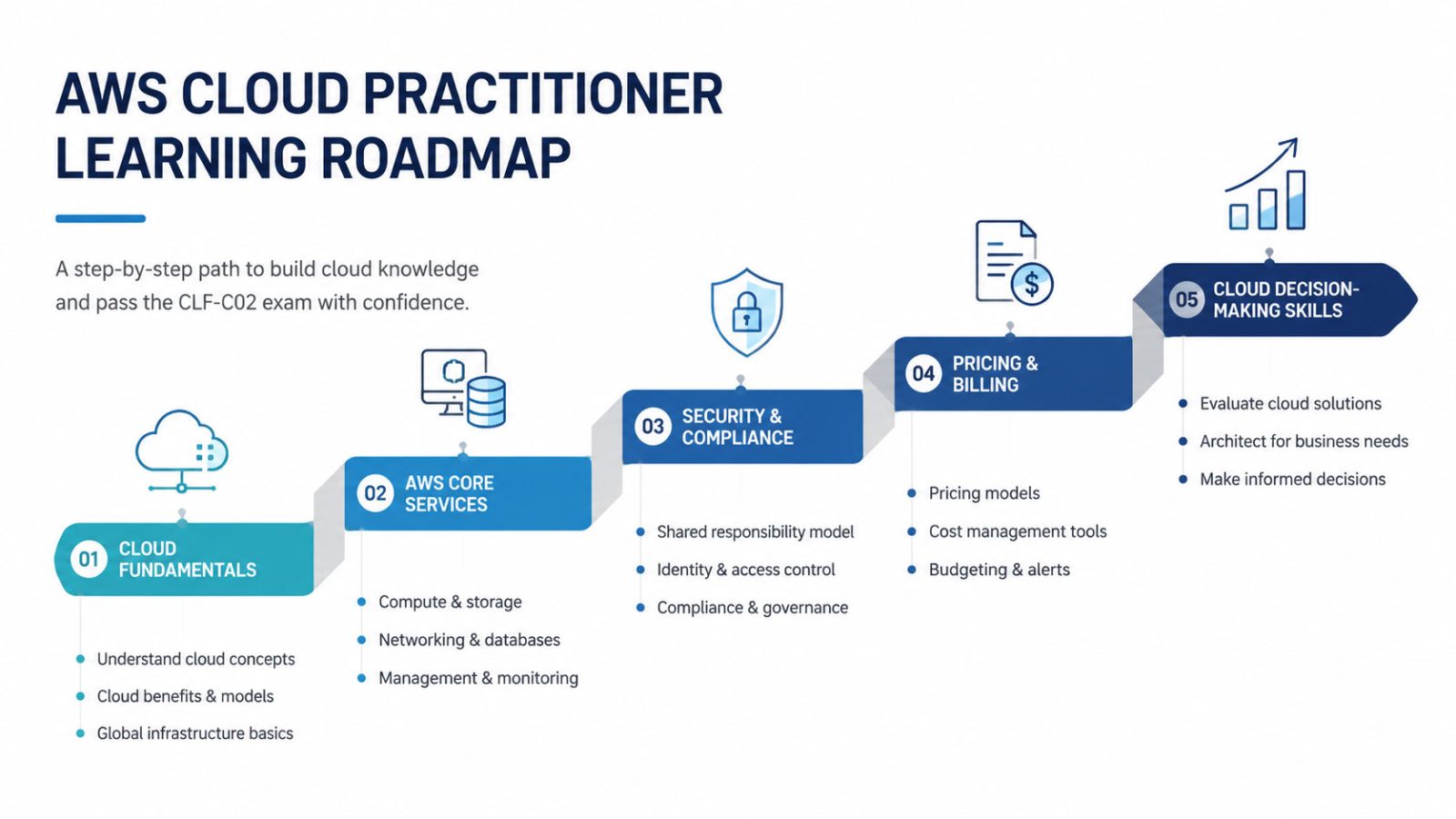
The AWS CLF-C02 exam measures foundational cloud knowledge across four major areas:
- Cloud concepts
- Security and compliance
- Cloud technology and AWS services
- Billing, pricing, and support
The exam is designed for understanding, not deep technical administration. AWS does not expect a Cloud Practitioner candidate to manage complex production environments. Instead, the certification confirms that you understand how AWS supports modern organizations.
I often describe CLF-C02 as a business and technology bridge. It connects technical concepts with organizational goals.
For example, a company moving from traditional infrastructure to AWS is not simply replacing physical servers with cloud resources. The company is changing how it handles scalability, operations, security, and costs.
A strong candidate understands questions like:
- Why would a company choose cloud computing?
- When should a business use managed services?
- Why does security responsibility change depending on the service?
- How can AWS reduce infrastructure limitations?
These questions represent real cloud thinking.
Beyond AWS Services: Understanding Cloud Decisions
One of the biggest improvements you can make during AWS CLF-C02 preparation is changing the way you view services.
A beginner may see Amazon EC2 as “a virtual machine service.”
A cloud professional sees EC2 as a computing option that provides flexibility and control while requiring more management responsibility.
A beginner may see AWS Lambda as “running code without servers.”
A cloud professional sees Lambda as a way to reduce infrastructure management for event-driven applications.
The difference is perspective.
AWS services exist because organizations have different requirements. There is rarely one universal solution.
A startup building a new application may prioritize speed and simplicity. A large enterprise managing critical workloads may prioritize control, governance, and predictable performance.
The same technology decision can change depending on:
- Business goals
- Security requirements
- Budget limitations
- Operational needs
- Application design
This approach is especially useful because AWS exam questions often describe a situation rather than directly asking for a definition.
How Cloud Concepts Connect Across AWS Environments
Real AWS environments are built from multiple services working together.
A simple application might involve:
| Business Need | AWS Category | Example Service |
|---|---|---|
| Run applications | Compute | Amazon EC2, AWS Lambda |
| Store files and backups | Storage | Amazon S3 |
| Manage application data | Database | Amazon RDS |
| Control access | Security | AWS IAM |
| Monitor performance | Operations | Amazon CloudWatch |
Understanding these relationships creates a stronger foundation than studying each service separately.
For example, imagine a company launching a customer-facing application.
The application needs computing resources, data storage, user access control, monitoring, and cost management. No single AWS service solves the entire problem. Cloud architecture comes from combining services based on requirements.
This is how experienced cloud professionals approach AWS decisions.
Where Your Preparation Time Creates Real Progress
Not every AWS topic deserves the same amount of study time. A focused preparation strategy produces better results than trying to explore the entire AWS ecosystem.
The areas that create the strongest foundation are security, core services, pricing, and operational concepts.
IAM and Security Foundations
Security is one of the most important areas in AWS because it affects every resource.
The foundation starts with AWS Identity and Access Management (IAM).
IAM controls who can access AWS resources and what actions they can perform. Understanding IAM helps you understand one of the most important cloud principles: access should match responsibility.
You should understand:
- Users
- Groups
- Roles
- Policies
- Permissions
- Authentication and authorization
IAM is not just another AWS service. It represents how cloud environments manage trust.
A common beginner question is: “Why does security receive so much attention in AWS?”
The answer is simple: cloud resources are accessible through software interfaces and APIs. Identity becomes a central security control.
The shared responsibility model is another essential concept.
AWS manages security of the cloud, including physical infrastructure, hardware, and foundational services.
Customers manage security in the cloud, including:
- Data protection
- User permissions
- Application security
- Resource configuration
The responsibility level changes depending on the service.
For example:
| Service | Customer Responsibility Level |
|---|---|
| Amazon EC2 | More control and management required |
| Amazon RDS | AWS manages more infrastructure tasks |
| AWS Lambda | AWS manages underlying servers |
Understanding this relationship helps answer many security questions.
Core AWS Services You Should Understand First
You do not need equal depth across every AWS service. Start with the services that represent major cloud categories.
Compute
Compute services provide the ability to run applications.
Amazon EC2 provides virtual servers with significant control.
AWS Lambda provides serverless execution where AWS manages the infrastructure.
The decision depends on requirements.
EC2 may fit workloads needing operating system control.
Lambda may fit applications that run when specific events occur.
Storage
AWS storage services solve different data requirements.
Amazon S3 provides scalable object storage.
Amazon EBS provides block storage connected to EC2 instances.
Amazon EFS provides shared file storage for multiple systems.
| Service | Storage Type | Typical Use |
|---|---|---|
| Amazon S3 | Object storage | Files, backups, archives |
| Amazon EBS | Block storage | EC2 application storage |
| Amazon EFS | File storage | Shared access across systems |
The important skill is knowing why these services exist.
Databases
AWS provides different database approaches because applications have different needs.
Relational databases organize structured information using tables and relationships.
NoSQL databases provide flexible structures for applications requiring different data models.
Managed database services reduce operational tasks by allowing AWS to handle maintenance activities.
The CLF-C02 exam focuses on understanding these choices rather than database administration.
Pricing, Reliability, and Operational Awareness
Understanding AWS pricing is another area where candidates can gain significant confidence during AWS CLF-C02 exam preparation. However, I often see learners approach pricing the wrong way. They try to focus on exact numbers or changing cost details, but AWS pricing evolves frequently. The more valuable skill is understanding the pricing models and why they exist.
Cloud computing changes the traditional infrastructure model. Instead of purchasing physical hardware upfront, organizations can use resources when needed and pay based on consumption.
This creates flexibility, but it also introduces new responsibilities.
A company that understands its workload can optimize costs effectively. A company that ignores resource usage may create unnecessary expenses.
Important AWS pricing concepts include:
- Pay-as-you-go pricing
- AWS Free Tier
- Reserved capacity options
- Savings Plans
- Cost monitoring tools
The decision depends on workload behavior.
A development team testing a new application may prefer flexibility because requirements are uncertain. An organization running predictable workloads for several years may benefit from longer-term pricing commitments.
The exam often tests whether you understand this relationship between usage patterns and pricing choices.
Reliability and Operational Thinking
Cloud platforms are not only about reducing infrastructure costs. Reliability and operational management are equally important.
AWS provides tools and services that help organizations build dependable systems.
The AWS Well-Architected Framework is especially useful because it introduces important cloud design principles:
- Operational excellence
- Security
- Reliability
- Performance efficiency
- Cost optimization
- Sustainability
You do not need to become an architect to understand these concepts. They help you recognize why AWS recommends certain approaches.
For example, a company running a critical application should consider availability and recovery planning. A company storing long-term data should consider durability and lifecycle management.
Cloud decisions always involve balancing different requirements.
A solution that is extremely flexible may require more management. A solution that reduces operational effort may provide less customization.
Understanding these trade-offs is what separates surface-level knowledge from practical cloud understanding.
Topics That Should Not Control Your Entire Preparation
One of the biggest improvements you can make while studying for AWS CLF-C02 is knowing where not to spend excessive time.
The AWS ecosystem is enormous. That can create a problem because learners often believe they must understand everything before taking the exam.
That approach usually slows progress.
The goal of the AWS Cloud Practitioner certification is to build foundational knowledge, not advanced specialization.
Avoid Spending Too Much Time on Advanced Details
Advanced AWS knowledge is valuable, but it belongs in the right learning stage.
For example, understanding Amazon VPC is important. You should know that it provides networking isolation and allows organizations to control communication between resources.
However, spending days exploring advanced networking configurations is unlikely to provide the same benefit as understanding broader cloud concepts.
The same applies to databases, automation tools, and specialized AWS services.
A good preparation question is:
“Will understanding this topic help me make a better cloud decision?”
If the answer is yes, continue.
If the topic is highly specialized and disconnected from the CLF-C02 objectives, it may be better saved for later certifications.
This approach creates a more efficient learning path.
Why Practice Scores Can Be Misleading
Practice tests are valuable, but they should be used correctly.
A high practice score does not automatically mean you understand AWS concepts. Sometimes it only shows that you recognize familiar question patterns.
The strongest candidates use practice questions as a learning tool.
After answering a question, analyze:
- Why is this option correct?
- Why are other options less suitable?
- What requirement is the question emphasizing?
- Which AWS principle does this represent?
This method improves your ability to handle unfamiliar scenarios.
AWS questions often include extra information. The challenge is identifying the important requirement.
For example, a question may describe a company that needs a highly available application. The important information is not the company industry or application details. The important concept may involve redundancy, availability zones, or managed services.
Learning to identify the decision factor is one of the most useful skills you can develop.
The AWS Comparison Skills That Matter
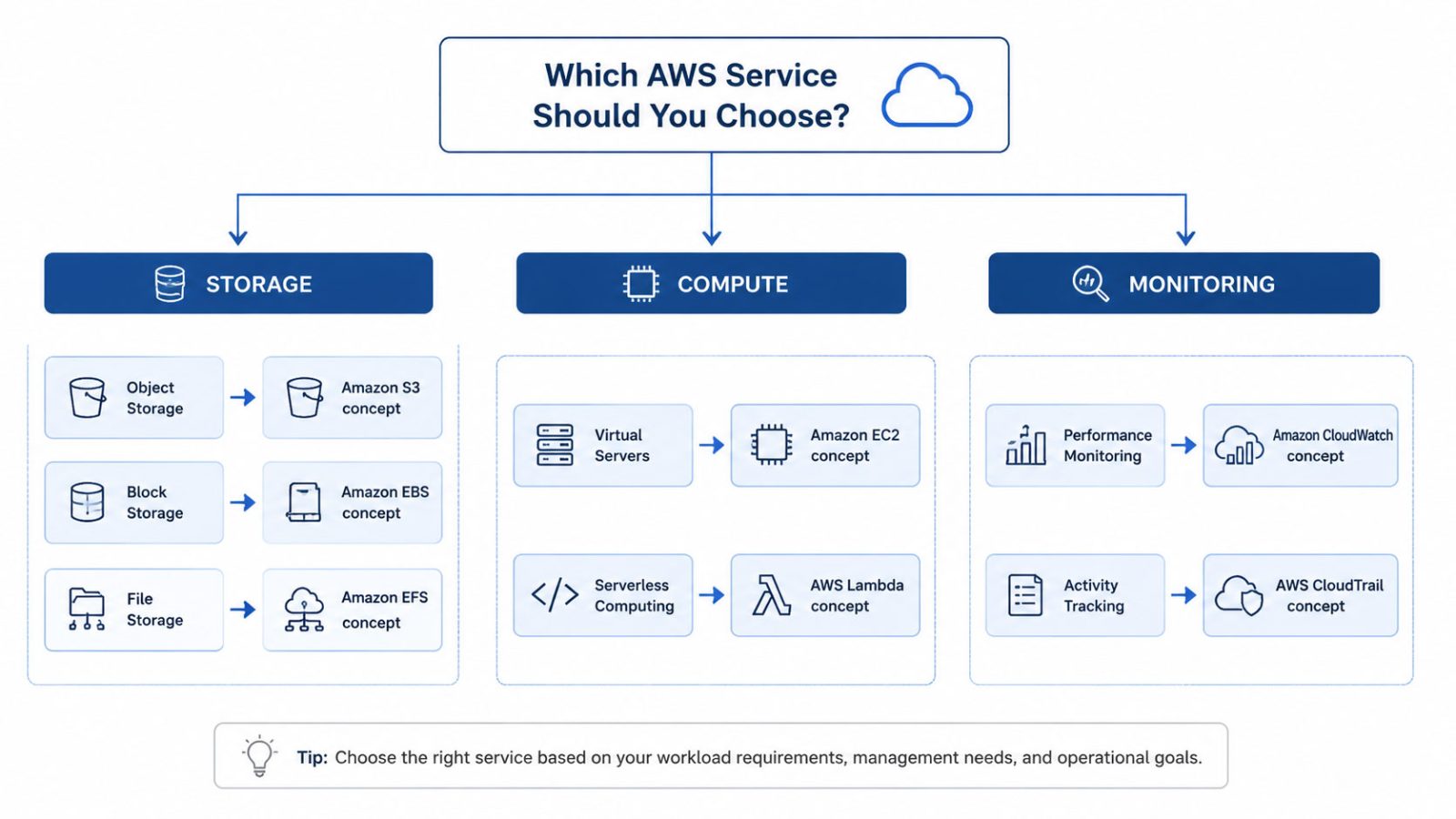
AWS CLF-C02 frequently tests whether you understand the differences between similar services.
Cloud professionals compare solutions based on purpose, not popularity.
A service is not automatically better than another. It is better for a specific requirement.
S3 vs EBS vs EFS
Storage is one of the clearest examples.
Although all three services store data, they solve different problems.
| Service | Storage Model | Best Understanding |
|---|---|---|
| Amazon S3 | Object storage | Large-scale storage for files, backups, and archives |
| Amazon EBS | Block storage | Persistent storage attached to EC2 |
| Amazon EFS | File storage | Shared file access across multiple systems |
Amazon S3 is designed for storing objects at massive scale.
Amazon EBS works like a disk attached to an EC2 instance.
Amazon EFS provides a shared file system that multiple resources can access.
The question is not “Which storage service is best?”
The better question is:
“What type of storage does this workload require?”
CloudWatch vs CloudTrail
These two services are frequently confused because both provide visibility.
However, they answer different questions.
| Service | Main Purpose | Question It Answers |
|---|---|---|
| Amazon CloudWatch | Monitoring and metrics | How is my system performing? |
| AWS CloudTrail | Activity tracking | What happened in my AWS account? |
CloudWatch helps teams monitor applications, resources, logs, and performance.
CloudTrail records API activity, helping organizations understand account actions and support auditing.
Both are important, but their purposes are different.
Security Hub vs GuardDuty
AWS security services also require clear comparison.
| Service | Purpose |
|---|---|
| Amazon GuardDuty | Detects potential threats and suspicious activity |
| AWS Security Hub | Aggregates security findings and evaluates security posture |
GuardDuty focuses on identifying threats.
Security Hub focuses on organizing security information and helping organizations manage security standards.
Understanding this difference makes security questions easier.
EC2 vs Lambda
The comparison between Amazon EC2 and AWS Lambda represents a fundamental cloud decision.
| Service | Approach | Best Fit |
|---|---|---|
| Amazon EC2 | Virtual servers | Applications requiring infrastructure control |
| AWS Lambda | Serverless execution | Event-driven applications requiring less management |
EC2 gives customers more control.
Lambda reduces infrastructure management.
The choice depends on application requirements.
A company running a customized enterprise system may prefer EC2.
A company processing uploaded images automatically may prefer Lambda.
A Better CLF-C02 Preparation Strategy For Different Backgrounds
The best study strategy depends on your starting point.
A complete beginner, an IT professional, and an existing AWS user all need different preparation approaches.
Complete Beginners
If cloud technology is new to you, start with the bigger picture.
Before exploring individual AWS services, understand:
- What cloud computing solves
- Why organizations move to cloud platforms
- How cloud differs from traditional infrastructure
- Why security, reliability, and cost matter
Then learn major AWS categories.
Think of AWS as an ecosystem rather than a collection of unrelated products.
Hands-on practice also helps. Exploring the AWS Console, creating simple resources, and observing how services work together can make concepts easier to understand.
The purpose is not building complex environments. The purpose is connecting concepts with practical experience.
IT Professionals Moving Into Cloud
IT professionals often have useful technical foundations, but cloud requires a different perspective.
Traditional IT frequently focuses on maintaining existing infrastructure.
Cloud environments encourage organizations to rethink how systems are designed and operated.
An administrator may ask:
“How do I manage this server?”
A cloud professional may ask:
“Do I need to manage this server, or is there a managed service that fits better?”
That change in thinking is important.
For IT professionals, CLF-C02 preparation should focus on AWS-specific concepts, service categories, cloud pricing, and architecture decisions.
Existing AWS Users
If you already work with AWS, your preparation strategy should focus on expanding your view beyond your daily responsibilities.
A developer who works mainly with Lambda may understand serverless applications well but may have limited knowledge of AWS pricing, governance, security services, or storage options.
A system administrator who manages EC2 instances may understand compute deeply but may not have explored managed databases or serverless solutions.
The Cloud Practitioner certification provides a broader perspective.
Use your existing experience as a foundation, then identify areas where your knowledge is narrow. The goal is to understand how AWS services fit together across an organization.
A strong cloud professional does not only understand individual tools. They understand how technology choices affect security, operations, and business outcomes.
Is AWS CLF-C02 Still Worth It In 2026?
The value of AWS Certified Cloud Practitioner depends on where you are in your career.
In 2026, cloud skills remain relevant across many technology roles. Organizations continue adopting cloud platforms because they need flexibility, scalability, and faster innovation.
However, a certification should be viewed realistically.
AWS CLF-C02 is not a replacement for practical experience. It does not make someone an experienced cloud engineer overnight. Its value comes from providing a structured foundation and demonstrating that you understand core AWS concepts.
For beginners, this foundation can be extremely useful.
For experienced professionals, the value depends on career goals.
Career Changers and Cloud Beginners
For people entering cloud technology, CLF-C02 can provide an organized starting point.
Learning cloud can feel overwhelming because it combines many areas:
- Infrastructure
- Security
- Networking
- Applications
- Data management
- Cost optimization
A foundation certification helps organize these topics into a logical framework.
However, the certification should be part of a larger learning path.
After gaining foundational knowledge, many candidates continue toward more specialized certifications.
Examples include:
| Career Direction | Related AWS Certification |
|---|---|
| Cloud architecture | AWS Solutions Architect Associate |
| Cloud operations | AWS SysOps Administrator |
| Cloud security | AWS Security Specialty |
The right path depends on your career objective.
Someone interested in designing cloud solutions may focus on architecture. Someone responsible for operating cloud environments may prefer operations-focused learning. Someone interested in protecting cloud workloads may move toward security.
How CLF-C02 Fits Into the AWS Certification Roadmap
I often see learners ask whether they should skip CLF-C02 and immediately pursue advanced certifications.
The answer depends on your background.
If you already understand networking, infrastructure, operating systems, and cloud concepts, moving directly to an associate-level certification may be reasonable.
For someone new to cloud, CLF-C02 can reduce the learning curve by creating a foundation first.
The AWS certification roadmap works best when each step builds on the previous one.
A possible progression could look like:
Cloud Foundation
↓
AWS Certified Cloud Practitioner
↓
Associate-Level Certification
↓
Professional or Specialty Certification
The important point is not collecting certifications. The goal is building useful skills that support your career direction.
What I Would Change If I Started CLF-C02 Again
If I started preparing for AWS CLF-C02 again in 2026, I would approach the process differently.
I would spend less time collecting resources and more time developing connections between concepts.
There are countless AWS courses, videos, articles, and practice exams available. More resources do not always create better results. A focused learning path usually creates stronger understanding.
I would begin with the questions cloud professionals ask:
Why does this service exist?
What problem does it solve?
What trade-off does it create?
For example, instead of simply learning that Amazon S3 provides object storage, I would connect it to real decisions:
A company needs highly durable storage for millions of files.
The company wants scalability without managing storage infrastructure.
The company needs flexible access options.
Now the service has context.
I would also spend more time comparing services because comparison creates clarity.
Understanding why a company chooses Lambda instead of EC2 teaches more than knowing the definition of both services.
Understanding why a company chooses S3 instead of EBS creates stronger storage knowledge.
Some learners use additional practice resources to evaluate their readiness before scheduling the exam, including resources such as https://www.leads4pass.com/clf-c02.html. These tools can be useful when combined with proper learning because practice questions help identify weak areas.
The biggest change I would make is focusing on developing cloud judgment.
Passing the exam is valuable, but the real benefit is gaining a foundation that allows you to continue learning AWS effectively.
Conclusion
AWS CLF-C02 in 2026 remains a useful starting point for anyone building cloud knowledge. Its purpose is not to turn beginners into cloud architects. Its purpose is to help learners understand the principles behind AWS services and how organizations make cloud decisions.
The strongest preparation approach is not trying to cover every AWS product. It is building a clear understanding of the concepts that appear repeatedly across cloud environments: security, reliability, pricing, service selection, and architecture thinking.
When you understand why AWS services exist and how they support business goals, the exam becomes much more manageable. More importantly, you develop the foundation needed for future certifications and real-world cloud work.
For me, the biggest lesson from watching AWS learners progress is simple: cloud knowledge grows faster when you focus on relationships between ideas instead of isolated information.
AWS CLF-C02 is the beginning of that journey, not the final destination.
Frequently Asked Questions
1. How long does it take to prepare for AWS CLF-C02?
Preparation time depends on your previous experience. Someone with an IT background may feel comfortable after a few weeks of focused study, while a complete beginner may need more time to understand cloud fundamentals. The quality of your understanding matters more than the number of study hours.
2. Can I pass AWS CLF-C02 without IT experience?
Yes. AWS CLF-C02 is designed as a foundational certification and does not require professional cloud experience. Beginners should focus on understanding cloud concepts, major AWS services, security principles, and pricing models before attempting the exam.
3. Should I get AWS CLF-C02 before AWS Solutions Architect Associate?
For beginners, CLF-C02 can provide a useful foundation before moving to AWS Solutions Architect Associate. However, experienced IT professionals with strong infrastructure knowledge may choose to start directly with associate-level certification preparation.
4. Does AWS CLF-C02 help me get a cloud job?
The certification can demonstrate foundational AWS knowledge, but employers usually evaluate a combination of certifications, practical skills, projects, and experience. CLF-C02 is most valuable when it supports hands-on learning and continued technical development.
5. What should I learn after AWS CLF-C02?
The next step depends on your career goals. Many learners continue with AWS Solutions Architect Associate for architecture skills, AWS SysOps Administrator for operations knowledge, or AWS Security Specialty for cloud security expertise.

Comments are closed.