
Network automation is not difficult because engineers cannot learn Python. The bigger challenge is understanding how infrastructure work changes when manual actions become repeatable workflows.
Why Network Engineers Need to Rethink Automation Before Learning It
When I speak with networking professionals about automation, the first concern is often predictable: “Do I need to become a programmer?”
That question makes sense because traditional networking has always been built around direct interaction. Engineers learn protocols, understand device behavior, troubleshoot failures, and use CLI commands to control infrastructure. The command line becomes a familiar environment where every action has a visible relationship between an engineer and a device.
Automation introduces a different way of thinking.
The biggest shift is not learning a programming language. It is learning how to describe a process that a system can repeat.
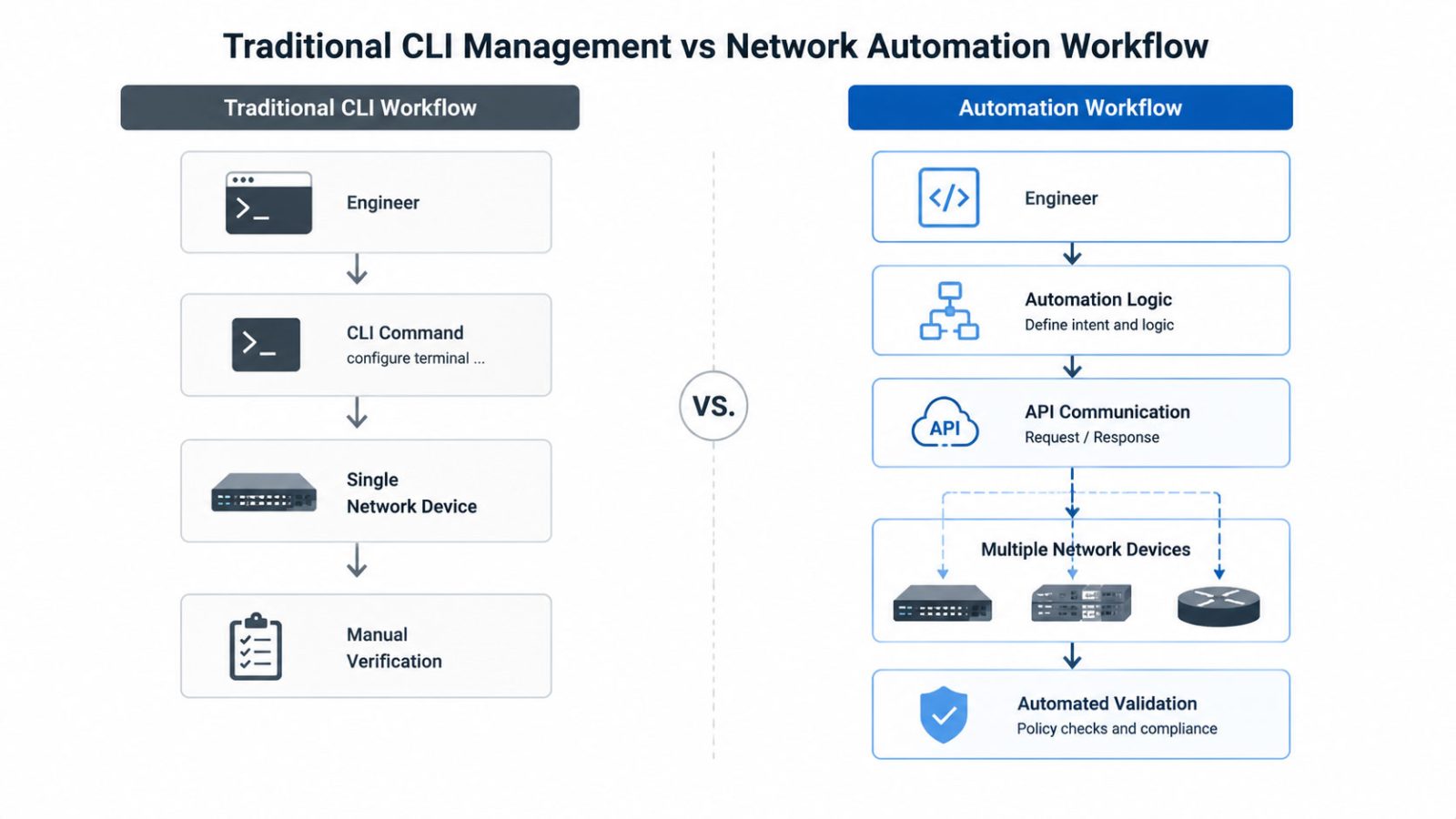
A network engineer who manually configures a switch understands the immediate relationship:
Engineer → Device → Configuration
The engineer makes a decision, enters commands, checks the result, and moves forward.
Automation changes that relationship:
Engineer → Workflow → API → Multiple Systems → Validated Result
The engineer is no longer only performing actions. The engineer is designing a process.
This distinction matters because modern infrastructure environments require consistency. A configuration change that works correctly on one device may not be enough when the same change must happen across hundreds of devices, multiple locations, or integrated platforms.
Automation does not replace networking knowledge. In practice, good automation depends on strong networking fundamentals.
A script cannot understand why a routing policy exists. An API cannot decide whether a security rule makes sense. A workflow cannot troubleshoot a design mistake.
Those decisions still require experienced engineers.
The role of automation is different. It helps engineers apply their knowledge more efficiently.
This is where many network professionals misunderstand the transition. They see Python, APIs, and software concepts and assume automation belongs to developers. In reality, network automation sits between networking and software. It gives infrastructure engineers additional tools to manage systems in a more scalable way.
Cisco 200-901 CCNAAUTO represents this connection. The value is not simply learning automation technologies. The deeper value is understanding how traditional networking knowledge connects with programmable infrastructure.
The Difference Between Managing Networks and Automating Networks
A useful way to understand automation is to compare two different operational approaches.
| Traditional CLI Network Management | Automation-Based Network Management |
|---|---|
| Engineer connects directly to devices | Engineer creates workflows that communicate with systems |
| Commands entered manually | Tasks executed through scripts, APIs, or automation tools |
| Changes performed individually | Changes applied consistently across multiple devices |
| Human verifies every step | Automated validation supports operations |
| Focus on device interaction | Focus on repeatable processes |
Neither approach is disappearing.
CLI remains one of the most important skills for network engineers. Troubleshooting a production issue often requires direct access, detailed protocol knowledge, and immediate analysis.
The difference is that CLI is no longer the only method engineers should understand.
Consider a realistic example.
A network engineer is responsible for collecting interface information from 20 switches.
Using traditional methods, the engineer may log into each device, run commands, copy output, and organize the information manually.
This approach works.
Now increase the environment to 500 switches.
The technical question changes.
The engineer is no longer solving:
“How do I display interface information?”
The engineer is solving:
“How can I collect accurate information from the entire environment repeatedly?”
That second question requires automation thinking.
The workflow might involve:
- using Cisco APIs to communicate with network platforms
- retrieving structured information
- processing JSON responses
- generating reports automatically
- validating results against expected conditions
The networking problem remains the same. The method of solving it changes.
This is why learning automation before understanding the operational difference can create frustration. Engineers sometimes begin with Python syntax but do not understand the infrastructure problem they are trying to solve.
The most effective approach starts with the workflow.
Why Traditional Networking Knowledge Still Matters Before Automation
There is a common assumption that automation represents the next stage beyond networking fundamentals.
I see it differently.
Automation builds on networking knowledge.
Before writing a script that changes configurations, an engineer needs to understand what those configurations actually do.
For example, automating a VLAN deployment requires more than knowing how to send commands to switches. The engineer needs to understand:
- VLAN behavior
- trunk configuration
- access policies
- operational validation
- possible failure scenarios
The same applies to routing automation.
A workflow that modifies routing settings requires knowledge of:
- routing protocols
- path selection
- redundancy design
- network impact
Automation increases the speed of execution. It does not replace engineering judgment.
This is one reason experienced network engineers often transition into automation successfully. They already understand the environment. They are adding another method of interaction.
The learning process becomes much easier when automation is viewed as an extension of infrastructure skills rather than a completely separate discipline.
What Network Engineers Often Misunderstand Before Starting Automation
One of the first misconceptions is that automation begins with writing complex code.
In reality, automation begins with identifying repeatable work.
A network engineer may already perform the same operational task every week:
- checking device versions
- collecting interface status
- verifying configurations
- reviewing system information
These tasks are strong candidates for automation because the process already exists.
The engineer understands:
- What information is required.
- Where the information comes from.
- What decisions should be made.
- What result is expected.
Programming becomes a method for expressing that process.
Python network automation is useful because Python provides a practical way to communicate with infrastructure systems, process information, and create repeatable workflows.
However, Python is not the final objective.
The objective is improving how infrastructure operations are performed.
A network engineer who learns Python without understanding networking may know how to manipulate data but struggle to create useful automation.
A network engineer who understands infrastructure but avoids automation entirely may continue relying on manual processes that become difficult to scale.
The combination creates the strongest foundation.
Understanding APIs Before Learning Automation
APIs are one of the concepts that create the biggest mental adjustment for traditional network engineers.
A CLI command produces output designed for a human.
An API provides information designed for systems.
For example, an engineer might run a command and visually read:
“Interface GigabitEthernet1/0/1 is up.”
An automation workflow may receive structured data containing:
- interface name
- operational status
- IP information
- configuration parameters
- device metadata
The difference is not just formatting.
Structured data allows software tools to analyze information consistently.
According to Cisco’s official documentation around network programmability, APIs and programmable interfaces allow applications and automation tools to interact with infrastructure platforms in a controlled way.
For engineers, understanding APIs means learning a new communication method.
The question changes from:
“What command shows this information?”
to:
“What system interaction provides this information?”
That change represents the foundation of network automation.
What Cisco 200-901 CCNAAUTO Actually Helps Network Engineers Understand
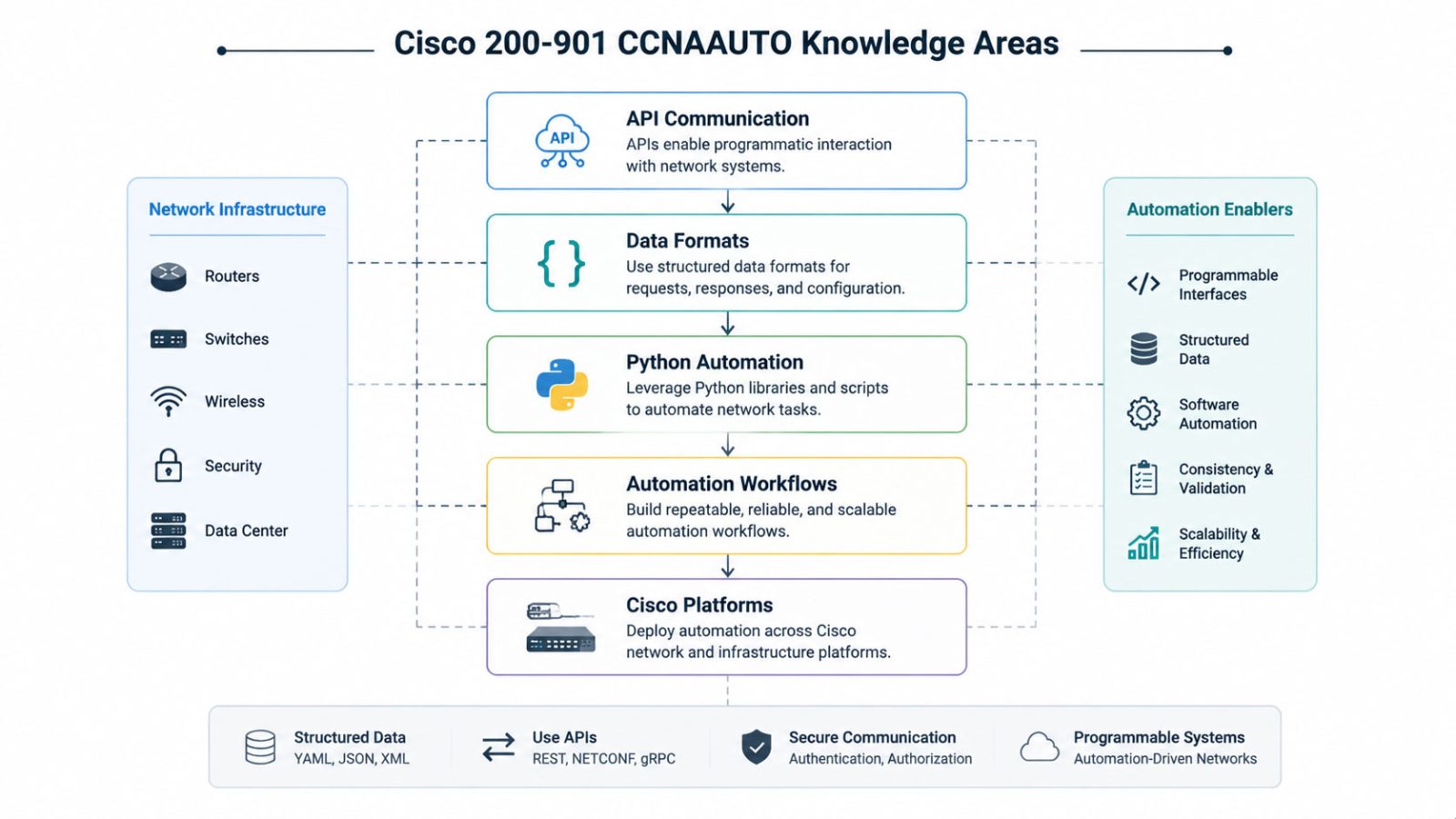
When engineers first explore Cisco 200-901 CCNAAUTO, the natural question is often about the exam itself: What topics are included? What technologies appear? How much programming is involved?
Those questions are reasonable, but they are not the most useful starting point.
The better question is:
What new way of thinking does this knowledge introduce to a network engineer?
The real value of Cisco 200-901 CCNAAUTO is not becoming familiar with a list of automation technologies. It is understanding how networking environments communicate with software systems and how repeatable operational workflows are created.
According to Cisco’s official certification information, the 200-901 DevNet Associate exam focuses on software development fundamentals, APIs, application deployment, security concepts, and automation related to Cisco platforms. The goal is not to turn infrastructure professionals into traditional software developers. Instead, it helps bridge the gap between network engineering and programmable infrastructure.
For a network engineer, that bridge includes several important concepts.
API Communication Becomes Part of Infrastructure Management
The first major change is understanding how applications communicate with network systems.
Traditional networking education often focuses on device interaction:
- access the device
- enter commands
- review output
- make adjustments
Automation introduces another layer:
- request information through an API
- process the returned data
- apply a defined action
- verify the result
Cisco APIs and programmable interfaces allow engineers to interact with infrastructure in ways that support automation workflows.
This does not mean every network task should immediately become automated. Some changes still require careful manual review, especially in complex production environments.
The point is learning when automation creates value.
A network engineer who understands APIs can evaluate whether a repetitive operational process can become more efficient, predictable, and easier to maintain.
Data Formats Become a New Way to Read Network Information
Another important transition is learning how infrastructure information is represented.
Network engineers are comfortable reading CLI output. Automation systems need structured information.
Formats such as JSON, XML, and YAML are commonly used because they allow systems to exchange information in a predictable format.
For example, a human engineer might look at a command output and immediately recognize:
“Port 1 is down.”
An automation workflow needs clearly defined data:
- interface identifier
- current state
- administrative status
- related configuration values
This is why data handling becomes an important automation skill.
The engineer is not learning data formats because they want to become a data analyst. They are learning because infrastructure increasingly communicates through structured information.
This change is similar to learning a new troubleshooting tool. The purpose is not the tool itself. The purpose is improving how problems are understood and solved.
Automation Workflows Connect Different Infrastructure Systems
Modern infrastructure rarely exists as isolated devices.
A network environment may connect with:
- cloud platforms
- monitoring systems
- security solutions
- identity platforms
- configuration management tools
Automation creates connections between these systems.
For example, a network team may need a workflow that checks device compliance after a configuration change.
A manual process could require engineers to:
- review device settings
- compare against standards
- document differences
An automated process could:
- collect configuration data
- compare against expected values
- generate a report
- notify the appropriate team
The engineer still defines the requirements and evaluates the results.
Automation simply creates a repeatable process around the task.
This is the mindset that Cisco 200-901 CCNAAUTO helps develop.
What Network Engineers Should Know Before Starting Automation
This section is the core question behind the article.
Before learning automation, network engineers should understand that the transition is not mainly about adding a programming language to their resume.
It is about changing how infrastructure problems are approached.
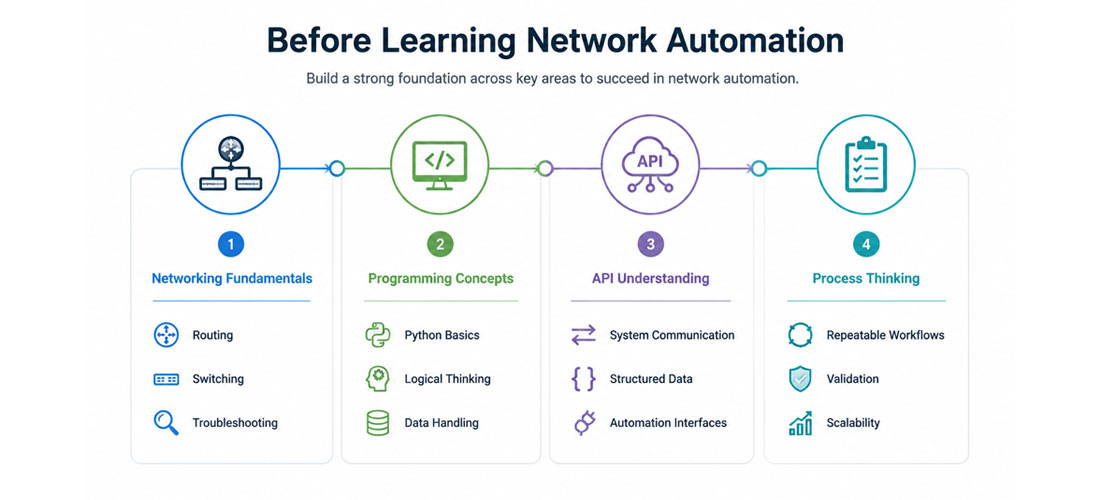
Networking Fundamentals Still Matter
Automation does not reduce the importance of networking knowledge.
In fact, the opposite is true.
A strong automation workflow depends on understanding the environment being automated.
Consider a simple example.
A company wants to automate access-layer switch deployment.
Someone needs to define:
- VLAN requirements
- interface behavior
- security policies
- validation steps
- rollback considerations
A script can execute these tasks quickly, but it cannot decide whether the design itself is correct.
The engineer must provide that understanding.
This is why professionals with CCNA or CCNP-level networking experience often find automation concepts easier to connect with real operations. They already understand the systems they are trying to automate.
For readers building their networking foundation first, resources related to Cisco CCNA and Cisco CCNP remain relevant because automation works best when built on strong infrastructure knowledge.
Programming Is a Tool, Not the Destination
The second important mindset shift is understanding the role of programming.
Network engineers sometimes approach automation with the assumption that they need to become software developers.
That creates unnecessary pressure.
Programming in network automation is a tool for solving infrastructure problems.
A Python script that collects device information is useful because it solves an operational challenge.
The value is not in the number of lines written.
A short script that removes repetitive manual work may have more practical impact than a larger application that does not solve a real problem.
Python network automation is useful because Python provides accessible ways to:
- interact with APIs
- process data
- automate repetitive tasks
- connect different systems
The destination is not programming expertise.
The destination is better infrastructure operations.
Troubleshooting Skills Remain Essential
Automation changes workflows, but troubleshooting remains a core engineering responsibility.
In some situations, automation creates new troubleshooting requirements.
An engineer may need to understand:
- why an API request failed
- why returned data is incomplete
- why an automated change produced an unexpected result
- whether the problem exists in the script or the network design
Traditional troubleshooting skills provide the foundation for answering these questions.
The engineer who understands network behavior can investigate automation failures more effectively.
This is another reason automation should not be viewed as a replacement for traditional networking.
It adds another layer of technical responsibility.
Automation Requires Process Thinking
The final concept before learning automation is process thinking.
Traditional troubleshooting often focuses on solving one problem:
“This device has an issue.”
Automation asks a broader question:
“How can this type of problem be identified and handled consistently?”
That difference changes the engineer’s role.
A process-focused engineer considers:
- repeatability
- reliability
- validation
- documentation
- scalability
For example:
A manual engineer might fix a configuration mismatch.
An automation-focused engineer might create a workflow that detects similar mismatches across the environment.
Both approaches require technical skill.
The second approach simply operates at a larger scale.
Before Learning Automation Checklist for Network Engineers
Before starting Cisco automation training, engineers should evaluate their current understanding.
| Area | Question to Consider |
|---|---|
| Networking fundamentals | Can I explain the behavior of the systems I want to automate? |
| CLI experience | Do I understand existing manual workflows? |
| APIs | Do I understand how systems exchange information? |
| Data formats | Can I read structured information such as JSON? |
| Programming mindset | Can I think through logical steps and processes? |
| Operations | Can I define what success and failure look like? |
This checklist is not about creating a barrier before learning automation.
It is about building the right foundation.
Automation becomes much easier when engineers understand both the technology and the operational purpose behind it.
Is Cisco 200-901 CCNAAUTO the Right Next Step?
The answer depends on where you are starting.
There is no single path that fits every technology professional.
For CCNA-Level Network Engineers
A CCNA-level engineer exploring automation should focus on connecting existing networking knowledge with new automation concepts.
The transition may feel unfamiliar because APIs and programming introduce different ways of thinking.
However, the networking foundation provides context.
The goal should be understanding how automation interacts with devices and workflows rather than trying to master every programming concept immediately.
For CCNP-Level Network Engineers
Engineers with deeper networking experience may find automation especially useful because they already understand complex operational environments.
A CCNP-level engineer may already work with:
- enterprise networks
- routing policies
- security requirements
- large-scale infrastructure
Automation skills can help transform that knowledge into repeatable operational processes.
The challenge is usually not networking complexity.
It is adapting from manual execution toward workflow design.
For Cloud Engineers
Cloud engineers often work with automation concepts already.
Infrastructure APIs, provisioning systems, and software-driven environments are common parts of cloud operations.
Cisco automation knowledge can strengthen understanding of network components within hybrid environments.
However, it should be viewed as a networking automation skill set rather than a complete cloud engineering pathway.
For Beginners Entering IT
Beginners should approach automation carefully.
Automation knowledge is useful, but it does not replace understanding how networks operate.
A beginner who learns scripting without networking fundamentals may understand tools without understanding consequences.
Building networking knowledge first creates a stronger foundation.
Automation becomes more meaningful when there is a real infrastructure problem to solve.
Practical Examples: How Network Engineers Apply Automation Skills After Learning the Concepts
Understanding automation concepts is only the beginning. The real change happens when engineers connect those ideas with operational problems they already understand.
When I evaluate how network teams adopt automation, I usually see the biggest progress when engineers start with familiar tasks rather than trying to build complex systems immediately.
A network engineer does not need to redesign an entire infrastructure environment to gain value from automation. The first step is usually identifying repetitive activities that consume time but require predictable decisions.
For example, consider a network engineer responsible for maintaining enterprise switches across multiple locations.
The manual process may involve:
- logging into devices individually
- checking software versions
- reviewing interface states
- collecting configuration information
- documenting results
The engineer already knows how to perform these tasks. The challenge is scale.
Automation changes the workflow.
Instead of manually collecting information from each device, the engineer can create a process that communicates with infrastructure platforms through APIs, retrieves the required data, and presents the results in a usable format.
The engineer is not replacing technical knowledge with code.
The engineer is creating a better method of applying that knowledge.
Scenario One: Automating Device Information Collection
One of the most practical starting points for network automation is inventory and information gathering.
Every network team needs accurate information about infrastructure:
- device models
- software versions
- interface status
- configuration details
- operational health
Manual collection becomes increasingly difficult as environments grow.
A Python network automation workflow could connect with supported Cisco platforms, retrieve information through APIs, and organize the results automatically.
The benefit is not only speed.
Consistency becomes equally important.
A manual report depends on how each engineer performs the task. An automated workflow follows the same process every time.
This creates a foundation for more advanced automation.
Once engineers become comfortable collecting information automatically, they can begin exploring validation, configuration management, and integration with other operational systems.
Scenario Two: Configuration Validation Before Changes Reach Production
Configuration validation is another area where automation provides practical value.
Network engineers already perform validation manually.
Before a change, an engineer may review:
- interface settings
- routing parameters
- security policies
- device versions
Automation can support this process by checking predefined conditions.
For example, before a configuration change is applied, a workflow could verify whether:
- required settings exist
- device versions meet requirements
- configuration standards are followed
This does not eliminate human review.
Complex network decisions still require engineering judgment.
Automation simply creates an additional layer of consistency.
This is an important distinction because some discussions around automation focus too heavily on replacing human tasks. In infrastructure operations, the stronger use case is usually supporting engineers with better information and repeatable processes.
The Career Transition: From Device Operator to Infrastructure Automation Engineer
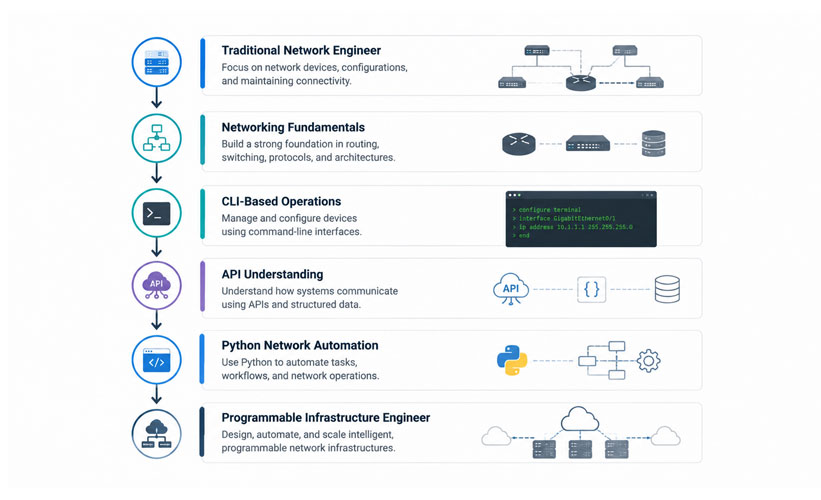
The transition toward automation does not happen overnight.
It is usually an expansion of existing responsibilities.
A traditional network engineer may begin with:
Networking Fundamentals
↓
CLI-Based Configuration
↓
Troubleshooting and Operations
↓
API Understanding
↓
Automation Workflows
↓
Programmable Infrastructure Management
This progression does not mean the original skills disappear.
The engineer still needs to understand:
- routing behavior
- switching concepts
- security requirements
- operational impact
Automation adds another layer of capability.
The most effective engineers in modern infrastructure environments are often those who can move between different perspectives:
- understanding network behavior
- interpreting infrastructure data
- designing repeatable workflows
- communicating with software-based systems
That combination allows them to work across traditional networking and modern infrastructure teams.
Where Cisco Automation Certification Fits in 2026
The role of Cisco automation certification has changed as infrastructure environments have become more software-driven.
A certification such as Cisco 200-901 CCNAAUTO should not be viewed as a replacement for networking expertise. It represents an additional skill area that helps engineers understand programmable infrastructure.
According to Cisco’s official certification information, the DevNet Associate path focuses on software development fundamentals, APIs, application development, security, and automation concepts related to Cisco technologies.
For network engineers, the important question is not:
“Will this turn me into a developer?”
The better question is:
“Will this help me understand how modern infrastructure communicates and operates?”
The answer depends on your current role and goals.
For an engineer managing enterprise networks, automation concepts can improve operational efficiency.
For someone working with hybrid cloud environments, these skills can improve collaboration between networking and cloud teams.
For someone entering IT, automation knowledge can provide useful exposure, but it works best alongside foundational networking knowledge.
Using Cisco Documentation as Part of the Learning Process
A strong automation learning path should include official technical resources.
Cisco provides documentation covering areas such as:
- APIs
- network programmability
- Cisco platform integrations
- automation technologies
Official documentation is especially valuable because automation depends heavily on platform-specific behavior.
A general programming tutorial may explain Python syntax, but it may not explain how a Cisco platform exposes information, handles requests, or supports automation workflows.
For network engineers, this connection between software concepts and infrastructure behavior is where the real learning happens.
The purpose is not simply writing scripts.
The purpose is understanding how technology components communicate.
Additional Resources for Cisco 200-901 Preparation
While hands-on experience and official Cisco resources should remain the foundation, some engineers also look for additional preparation materials when reviewing certification-related concepts.
For readers who are exploring extra study resources related to Cisco 200-901, additional preparation materials can be found through resources such as Cisco 200-901 preparation resources.
These types of resources should be evaluated carefully and used as a supplement to official documentation, practical labs, and real automation exercises.
The strongest understanding comes from combining structured learning with hands-on experimentation.
The Mistake of Learning Automation Without a Real Problem to Solve
One pattern I have noticed in automation discussions is that engineers sometimes focus too much on tools.
They ask:
“Should I learn Python?”
“Should I learn Ansible?”
“Should I learn APIs?”
Those questions are useful, but they come after a more important question:
“What infrastructure problem am I trying to improve?”
Tools are only valuable when connected to operational needs.
A Python script without a purpose is simply code.
An automation workflow connected to a real network challenge becomes engineering.
For example:
A script that collects device information solves a visibility problem.
A workflow that validates configurations solves a consistency problem.
An API integration between systems solves an operational communication problem.
The technology matters, but the problem defines the value.
My Perspective on Network Automation in 2026
When I look at the direction of networking, I do not see a competition between engineers who know CLI and engineers who know automation.
That comparison misses the real transition.
The strongest professionals will understand both sides.
They will know how packets move through networks, how protocols behave, and how infrastructure should be designed. At the same time, they will understand how APIs, scripts, and automation workflows can make those environments easier to operate.
The network engineer role is expanding.
The expectation is not that every engineer becomes a software developer. The expectation is that engineers understand how infrastructure connects with software-driven operations.
Cisco 200-901 CCNAAUTO is part of that transition because it introduces the concepts that connect networking knowledge with automation practices.
The engineers who benefit most will not be those who abandon traditional networking.
They will be the ones who recognize that automation is another way to apply networking expertise.
The future network engineer will not choose between networking and coding.
The competitive advantage will come from understanding how both disciplines work together.
Conclusion
Before learning automation, network engineers need to understand one important idea: automation is not a replacement for networking skills.
It is a different way of applying them.
Cisco 200-901 CCNAAUTO provides a bridge between traditional infrastructure knowledge and programmable network operations. The concepts behind APIs, Python network automation, structured data, and workflow design help engineers understand how modern environments are managed.
The most important preparation is not memorizing automation tools.
It is developing the right mindset.
Network engineers who understand their infrastructure, think in processes, and learn how systems communicate will be better prepared for the changing expectations of modern operations.
The next generation of networking will not separate engineers into “network people” and “coding people.”
The strongest engineers will understand where those skills meet.


Comments are closed.