
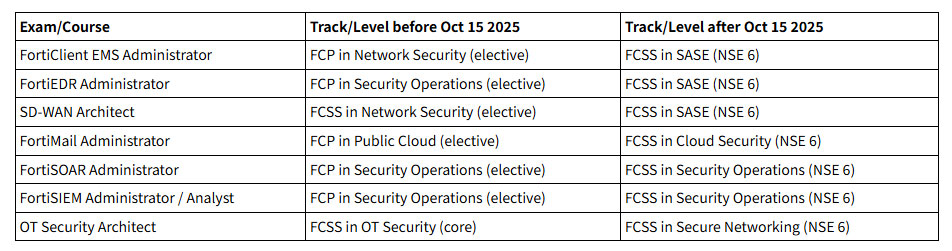
Fortinet’s 2026 move to revive the NSE branding reflects a larger industry reality: enterprises have a hard time embracing experimental certification labels like FCSS or FCP. Despite internal pushes toward rebranding, most security teams and hiring managers still recognize NSE titles, particularly NSE7, as shorthand for advanced competency in operational security. If you’ve been in hiring conversations over the past few years, you’ve likely heard phrases like:
“We’re looking for someone NSE7-certified who can handle FortiSIEM and FortiSOAR end-to-end.”
Many teams never fully adopted the FCSS naming structure internally. In recruitment, “NSE7” carries more weight than newer brand layers. Even LinkedIn job postings show that NSE certifications appear far more often than the FCSS equivalents. This is a crucial point for any SOC engineer evaluating their certification roadmap: recognition matters as much as technical knowledge. Fortinet isn’t just rebranding for marketing; it’s aligning its certification to enterprise operational reality.
The Real Question Isn’t the Exam — It’s the Future of SOC Operations
The value of NSE7_SOC_AR-7.6 is often misunderstood because people focus solely on the exam. Modern SOCs are evolving far beyond monitoring firewalls. Analysts are increasingly tasked with automation, threat hunting, and orchestrating complex playbooks in line with frameworks like MITRE ATT&CK.
Traditional SOC fatigue is a real concern. Alerts pile up endlessly, and manual triage has become unsustainable. Enter FortiSOAR: orchestration that can reduce alert fatigue and streamline response workflows. NSE7_SOC_AR-7.6 tests skills that align more closely with operational decision-making than purely device management, emphasizing cross-product automation, correlation logic, and incident response workflows.
This shift is industry-wide. Security teams are prioritizing detection engineering and actionable intelligence. Certifications that reflect these skills, rather than just firewall configuration, are gaining strategic weight. In practical terms, a candidate with NSE7_SOC_AR-7.6 is often positioned as someone who can bridge SIEM, SOAR, and operational decision-making, a capability that remains in high demand.
Why NSE7_SOC_AR-7.6 Sits in an Unusual Position Right Now
The 2026 timeline gives this certification a peculiar but strategic advantage. The exam itself hasn’t been retired, yet Fortinet is rolling out updated paths and rebranding layers. This liminal phase makes NSE7_SOC_AR-7.6 a low-competition credential for engineers who can commit to learning the material deeply.
Content scarcity adds another layer. High-quality technical resources are few and far between, while search results are cluttered with low-value content. For engineers willing to navigate this landscape, it’s an opportunity to differentiate themselves: rare certification + practical SOC focus = high career leverage.
What Experienced SOC Engineers Usually Notice About This Certification
Veteran SOC engineers often comment that the exam feels less like a rote test and more like a simulation of operational decision-making. The key areas include:
- Correlation logic – understanding how to connect alerts across devices and detect real threats.
- Incident workflows – mapping playbooks to real-world SOC tasks.
- Automation mindset – using SOAR to reduce manual labor while improving accuracy.
- Operational visibility – knowing what metrics truly matter and how to surface them efficiently.
- Cross-product integration – ensuring FortiSIEM, FortiSOAR, and FortiGate work as a cohesive ecosystem.
Many analysts report that preparing for this exam pushes them to think like an SOC architect, rather than just a firewall administrator.
Where the Certification Still Falls Short
Despite its advantages, NSE7_SOC_AR-7.6 isn’t a universal solution. For example:
- FortiSOAR adoption lags behind competitors like Splunk or Palo Alto Cortex. Large enterprises may still prefer established platforms.
- Enterprise adoption is uneven; not all SOC teams use Fortinet’s full ecosystem.
- Smaller companies or helpdesk roles may find limited practical benefit.
- It doesn’t teach deep network security fundamentals — so candidates without prior SOC experience may struggle.
These limitations make it important for engineers to assess whether the certification aligns with their environment and career trajectory.
Who Should Actually Consider NSE7_SOC_AR-7.6 in 2026
Ideal candidates:
- SOC analysts moving toward engineering roles
- Detection engineers or SIEM administrators
- MSSP engineers
- Fortinet ecosystem architects seeking operational credibility
Not ideal for:
- Complete newcomers to SOC
- Helpdesk or network-only engineers
- Professionals without exposure to FortiSIEM/FortiSOAR environments
This distinction is crucial. Attempting the exam without operational exposure often leads to frustration rather than career leverage.
Related Fortinet Certifications Worth Comparing
FortiGate Foundation Path (NSE4_FGT_AD-7.6)
For professionals still building foundational skills, the FortiGate administrator track (NSE4_FGT_AD-7.6) is the natural starting point before moving into SOC-focused roles. It ensures that engineers gain solid grounding in firewall operations, network security basics, and device management—skills that remain critical even as SOC automation and SIEM/SOAR orchestration become more prominent. Think of it as your operational toolkit: without mastering the fundamentals, advanced SOC workflows can feel abstract and harder to implement in real-world scenarios.
SSE / SASE Direction (NSE7_SSE_AD-25)
Engineers looking to expand into cloud-delivered security and next-generation network architectures may explore NSE7_SSE_AD-25, which emphasizes SASE and SSE principles. This path is ideal for those seeking to combine Fortinet expertise with cloud-native security strategies, zero-trust architecture, and secure edge integration. For SOC engineers, understanding these frameworks complements SOC automation skills, particularly in hybrid enterprise environments where cloud and on-premise systems need coordinated threat detection and response.
Hands-On Preparation for Real SOC Skills
Fortinet’s SOC-focused practice environments remain limited, which makes practical, hands-on experience far more important than memorizing answers. Many online resources promise “quick exam solutions,” but these rarely equip candidates with the skills needed in real-world security operations. Engineers who focus on scenario-based labs, simulated alert triage, and automated playbook exercises gain the operational thinking that SOC teams actually value.
Some candidates choose to supplement their preparation with resources like Leads4Pass, not as a shortcut, but to reinforce concepts through realistic, scenario-driven questions. The true advantage comes from applying knowledge in practice: correlating alerts across systems, orchestrating FortiSOAR playbooks, and interpreting FortiSIEM insights. This approach builds the kind of intuition and confidence that translates directly into professional effectiveness, rather than just passing a test.
Career Impact and Long-Term Considerations
SOC automation is more than a technical skill—it’s a career lever. Engineers who can deploy FortiSOAR, integrate detection logic, and operationalize SIEM workflows position themselves for leadership in threat detection and incident response.
Detection engineering is increasingly valued, and NSE7_SOC_AR-7.6 signals proficiency in both operational and strategic dimensions. While not the most mainstream credential, it offers an advantage to engineers who focus on practical SOC delivery over textbook theory. The Fortinet ecosystem also opens doors for cross-platform roles, MSSP operations, and specialized automation functions.
Conclusion:
Fortinet’s decision to revive the NSE brand underscores a broader trend: enterprise recognition outweighs branding experiments, and SOC engineers are now measured more by operational impact than vendor knowledge alone. NSE7_SOC_AR-7.6 may not become the most popular certification, but its relevance lies in rewarding engineers who operate at the intersection of automation, SIEM/SOAR integration, and detection engineering. For those committed to modern SOC operations, this credential remains a strategic asset.
FAQs
- Is NSE7_SOC_AR-7.6 still relevant in 2026?
Yes. Despite certification shifts, it provides hands-on operational knowledge that aligns with modern SOC requirements. - Can beginners take this certification?
It is not recommended for absolute beginners. Prior SOC experience significantly improves success and applicability. - How does NSE7_SOC_AR-7.6 compare to FortiGate certifications?
FortiGate certifications cover device administration, while NSE7_SOC_AR-7.6 emphasizes SOC automation, incident workflows, and SIEM/SOAR integration. - Is FortiSOAR market adoption a limitation?
Yes, adoption lags behind competitors, which may reduce practical exposure in some enterprises. - Does this certification improve career prospects?
For engineers focused on SOC automation, detection engineering, or MSSP operations, it offers strong differentiation in a niche but growing field.


Comments are closed.