
Most candidates preparing for SOA-C03 focus on exam topics. In reality, the more interesting question is why AWS decided to retire the SysOps Administrator name after years of industry recognition.
What I see in hiring discussions is that the title change reflects something much bigger than certification branding. AWS is signaling that modern operations teams are expected to think beyond servers, dashboards, and tickets. The future belongs to engineers who automate, observe, recover, and continuously improve cloud systems at scale.
Why AWS Retired the SysOps Administrator Name
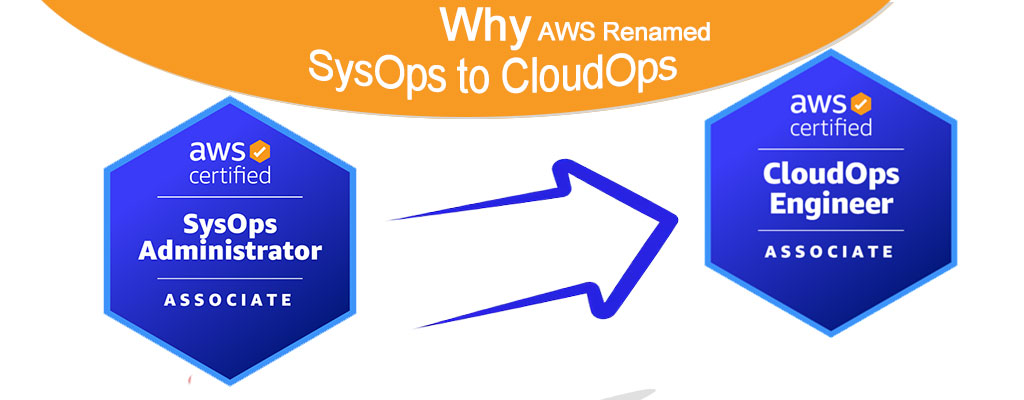
AWS openly states that the certification was renamed to reflect the evolving nature of cloud operations and changing industry terminology. The new credential is officially called AWS Certified CloudOps Engineer – Associate, replacing the older SysOps Administrator title.
From Server Administration to Cloud-Native Operations
One of the biggest changes between 2020 and 2026 is that operations teams stopped thinking primarily about servers. In traditional environments, administrators focused on maintaining operating systems, patching machines, monitoring CPU utilization, and handling outages manually. Cloud environments transformed that reality. Today, engineers often manage thousands of resources that are provisioned automatically and may exist for only a few hours before disappearing.
What teams are actually struggling with is not server administration. They are struggling with visibility, automation, governance, and operational consistency across rapidly changing environments. The word “SysOps” carries historical baggage from an era where infrastructure was relatively static. The word “CloudOps” better reflects environments that constantly evolve through automation pipelines, infrastructure templates, and container orchestration systems.
AWS likely recognized something many hiring managers already understood. Organizations are no longer searching for administrators who manage cloud resources manually. They want engineers who can create operational systems capable of managing themselves whenever possible.
Automation Changed the Definition of Operations
The modern operations engineer spends less time clicking through management consoles and more time building automation. Infrastructure as Code, policy automation, event-driven remediation, and continuous deployment have fundamentally changed the profession.
An interesting observation rarely discussed in certification guides is that successful operations teams increasingly measure how little manual work they perform. In many organizations, operational excellence means eliminating recurring operational tasks entirely. The best engineer is often the one who prevents future tickets rather than resolving today’s tickets.
AWS’s own exam blueprint now places significant emphasis on monitoring, automation, reliability, remediation, and deployment activities. These are engineering disciplines rather than traditional administrative responsibilities.
Containers and Infrastructure as Code Reshaped the Role
Containerization has accelerated this transformation. Many workloads no longer have long-lived servers that require hands-on management. Kubernetes, Amazon ECS, AWS Lambda, and automated deployment systems encourage engineers to think in terms of services rather than machines.
A useful analogy is comparing cloud operations to managing a city instead of maintaining a single building. The challenge is no longer fixing individual systems. The challenge is designing processes that keep thousands of moving parts functioning together. That mindset aligns much more closely with CloudOps than SysOps.
The Biggest Misunderstanding About SOA-C03
Why It Is Not Simply an Administration Certification
The biggest misunderstanding about SOA-C03 is that candidates often treat it as an AWS administration certification. That interpretation is becoming increasingly outdated.
AWS describes the certification as validating skills related to monitoring, reliability, automation, security, networking, troubleshooting, and operational management. Notice how few of those areas involve traditional administration.
When I review resumes, I rarely ask whether someone can create an EC2 instance. That task can be automated in seconds. Instead, I want to know whether they can identify why latency suddenly increased across multiple regions, determine root cause, and implement a permanent solution.
The difference is subtle but important. Administration focuses on operating systems and infrastructure resources. Operations engineering focuses on systems behavior, reliability, resilience, and continuous improvement.
The Engineering Mindset Behind the Exam
The strongest SOA-C03 candidates often think like reliability engineers. They are interested in preventing incidents, measuring performance, automating remediation, and reducing operational risk.
One overlooked signal from AWS is how heavily the new exam emphasizes monitoring, analysis, reliability, business continuity, and automation. These domains collectively represent a substantial portion of the certification.
That emphasis mirrors what organizations increasingly demand in production environments. Businesses care less about whether infrastructure exists and more about whether customers can consistently use applications without interruption.
What Companies Actually Expect From CloudOps Engineers

Observability as a Core Skill
Observability has become one of the defining skills of modern CloudOps engineers.
Many candidates still focus on monitoring dashboards. Observability is different. It involves understanding why systems behave the way they do. Logs, metrics, traces, events, and telemetry all contribute to a complete picture of operational health.
Lessons from cloud operations teams reveal a recurring pattern. Most outages are not caused by a lack of monitoring. They occur because organizations have data but cannot interpret it quickly enough during incidents.
The engineers who advance fastest are often those who can connect symptoms to root causes across complex distributed systems.
Incident Response and Resilience
Hiring managers increasingly evaluate operational candidates through incident scenarios rather than technical trivia.
Imagine a payment service experiencing intermittent failures across multiple Availability Zones. The real question is not whether an engineer knows a specific AWS feature. The real question is whether they can diagnose issues under pressure, coordinate response efforts, communicate effectively, and restore service quickly.
That ability separates operators from operations engineers.
Resilience engineering has become a major differentiator because businesses now assume failures will happen. The objective is not eliminating failure entirely. The objective is minimizing customer impact when failure occurs.
Multi-Account and Large-Scale Operations
One observation rarely mentioned in exam preparation material is that cloud complexity increasingly comes from organizational scale rather than technical complexity.
A startup might manage a handful of AWS accounts. Large enterprises may manage hundreds or thousands. Governance, visibility, permissions, compliance, and operational consistency become massive challenges.
This explains why CloudOps engineers are becoming more valuable. They sit at the intersection of technology, operations, security, and organizational scalability.
Why CloudOps Became More Important After AI
AI Creates More Infrastructure, Not Less
A common assumption is that AI will reduce operational jobs.
What I see in practice is almost the opposite.
AI applications require infrastructure. They need compute resources, storage systems, networking, observability platforms, security controls, data pipelines, and monitoring frameworks. Every new AI workload introduces additional operational complexity.
Organizations deploying AI systems often discover that operational requirements grow faster than expected. Inference workloads, model updates, scaling demands, and compliance concerns create entirely new categories of operational challenges.
The result is more infrastructure to manage, not less.
Operational Complexity Is Growing Faster Than Headcount
Another overlooked trend is that infrastructure growth is outpacing operations team growth.
Companies are not hiring ten times more engineers to manage ten times more cloud resources. Instead, they expect automation and CloudOps practices to bridge the gap.
This creates a fascinating career opportunity. Engineers who understand automation, observability, and resilience become force multipliers. Their value comes from enabling organizations to scale without proportionally increasing operational staffing.
Ironically, AI may increase the strategic importance of CloudOps engineers because complexity is becoming the primary operational challenge.
SOA-C03 vs SAA-C03: The Career Question Nobody Answers Properly
Startup Hiring Scenarios
Candidates often ask whether they should pursue SAA-C03 or SOA-C03.
The answer depends less on certification difficulty and more on career direction.
In startups, roles frequently overlap. A cloud engineer might design infrastructure in the morning, troubleshoot incidents in the afternoon, and automate deployments in the evening.
In those environments, SAA-C03 often provides broader architectural knowledge. However, operational skills frequently determine whether services remain available when growth accelerates.
Enterprise and Platform Team Roles
Enterprise environments create clearer specialization.
Architects focus on design decisions, governance frameworks, and technology strategy. CloudOps engineers focus on operational excellence, resilience, monitoring, automation, and incident response.
Architects answer, “What should we build?”
CloudOps engineers answer, “How do we keep it running reliably at scale?”
That distinction becomes increasingly important in platform engineering teams.
Where DVA-C02 and DOP-C02 Fit
The AWS certification roadmap often creates confusion because candidates assume certifications represent seniority levels. In reality, they often represent different perspectives.
- SAA-C03 focuses on architecture.
- DVA-C02 focuses on application development.
- SOA-C03 focuses on operational excellence.
- DOP-C02 focuses on advanced automation and DevOps practices.
Many successful professionals eventually combine multiple perspectives. The strongest platform engineers frequently blend architecture knowledge, development understanding, and operational expertise.
Is SOA-C03 Worth It in 2026?
Who Benefits Most
SOA-C03 provides significant value for professionals working in:
- Cloud operations
- Site reliability engineering
- Platform engineering
- DevOps environments
- Cloud support roles
- Infrastructure engineering
The certification aligns particularly well with engineers responsible for maintaining production systems.
An additional practice resource some candidates use during preparation is:
https://www.leads4pass.com/soa-c03.html
The certification is also valuable for professionals who already possess technical knowledge but need formal validation of operational capabilities.
Who Should Skip It
Not everyone benefits equally.
If your primary goal is cloud architecture consulting, solution design, or pre-sales architecture, SAA-C03 may provide a more direct return.
Similarly, developers focused primarily on application development may gain more immediate value from DVA-C02.
One of the most expensive mistakes candidates make is pursuing certifications because they appear popular. The better approach is aligning certifications with the work you actually want to perform.
SOA-C03 is strongest when your career revolves around operating production environments rather than designing them.
What I Believe AWS Is Signaling About the Future
The Rise of Platform Engineering
AWS rarely changes certification names without reason.
The shift from SysOps to CloudOps suggests that AWS sees operations becoming more engineering-oriented and more platform-focused.
Platform engineering is emerging as one of the most influential disciplines in cloud computing. Organizations increasingly create internal platforms that enable developers to deploy and operate services efficiently without managing every underlying detail.
CloudOps engineers often become the builders and maintainers of those platforms.
Automation and Observability as Career Multipliers
The most important signal is not the certification title itself.
The signal is the concentration of skills AWS emphasizes. Monitoring. Reliability. Automation. Business continuity. Incident management. Operational analysis. These themes appear repeatedly throughout the SOA-C03 blueprint.
A pattern emerges when you examine hiring trends between 2020 and 2026. Organizations increasingly reward engineers who can create self-healing systems, improve operational visibility, reduce manual effort, and maintain resilience during failure.
Those capabilities scale.
Traditional administration often scales linearly with infrastructure growth. Modern CloudOps engineering scales exponentially through automation.
That distinction may define the next decade of cloud careers.
Conclusion
The most interesting part of SOA-C03 is not the updated exam objectives. It is the message behind them.
AWS appears to be acknowledging what many cloud teams already learned through experience: operational excellence is no longer about managing systems manually. It is about creating automated, observable, resilient platforms that can support increasingly complex workloads.
My prediction is that by the end of this decade, the highest-performing cloud operations professionals will look less like administrators and more like platform engineers. AWS didn’t simply rename a certification. It redefined the type of professional it expects cloud operations teams to become.

Comments are closed.